Logo of the Accessible Security and Safety Technologies, ASSET group at the University of Rhode Island. The logo is a vertical image of a key on a mustard colored background with the names of the ASSET group written to its side.

HCC: Small: Using Virtual Reality Technologies for Post-Trauma Self Regulation for Adults with Intellectual and Developmental Disabilities

Trauma is defined as a sudden, potentially deadly experience that often leaves lasting, troubling memories. In the US, a significant number of the 7 million people with intellectual and developmental disabilities (I/DD) have experienced trauma. I/DD (e.g., Down syndrome, Williams syndrome, Smith-Magenis syndrome, etc.) are a set of disabilities that negatively affect the trajectory of an individual's intellectual, emotional, and/or physical development. The presence of trauma causes many negative side effects for individuals with I/DD (e.g., a general sense of grief, anxiety, depression, self-harming behavior, etc.). There are often substantial systemic and personal barriers that prevent or impede people with I/DD from accessing therapy to deal with their trauma. Given these difficulties, it is essential to find means to help them cope with the negative side effects of trauma. Post-trauma self-regulation (PTSR) is the act of engaging in activities that focus one's attention, to temper the negative emotions and feelings in a given situation in the aftermath of trauma. Our aim is to offer individuals with I/DD a virtual reality (VR)-based digital tool they can use to engage in PTSR to self-manage the negative consequences of trauma, given the constraints on their lives.

Funding: Supported by the National Science Foundation (NSF), Award IIS - 2408481. PI: Krishna Venkatasubramanian.

Publications

CACM

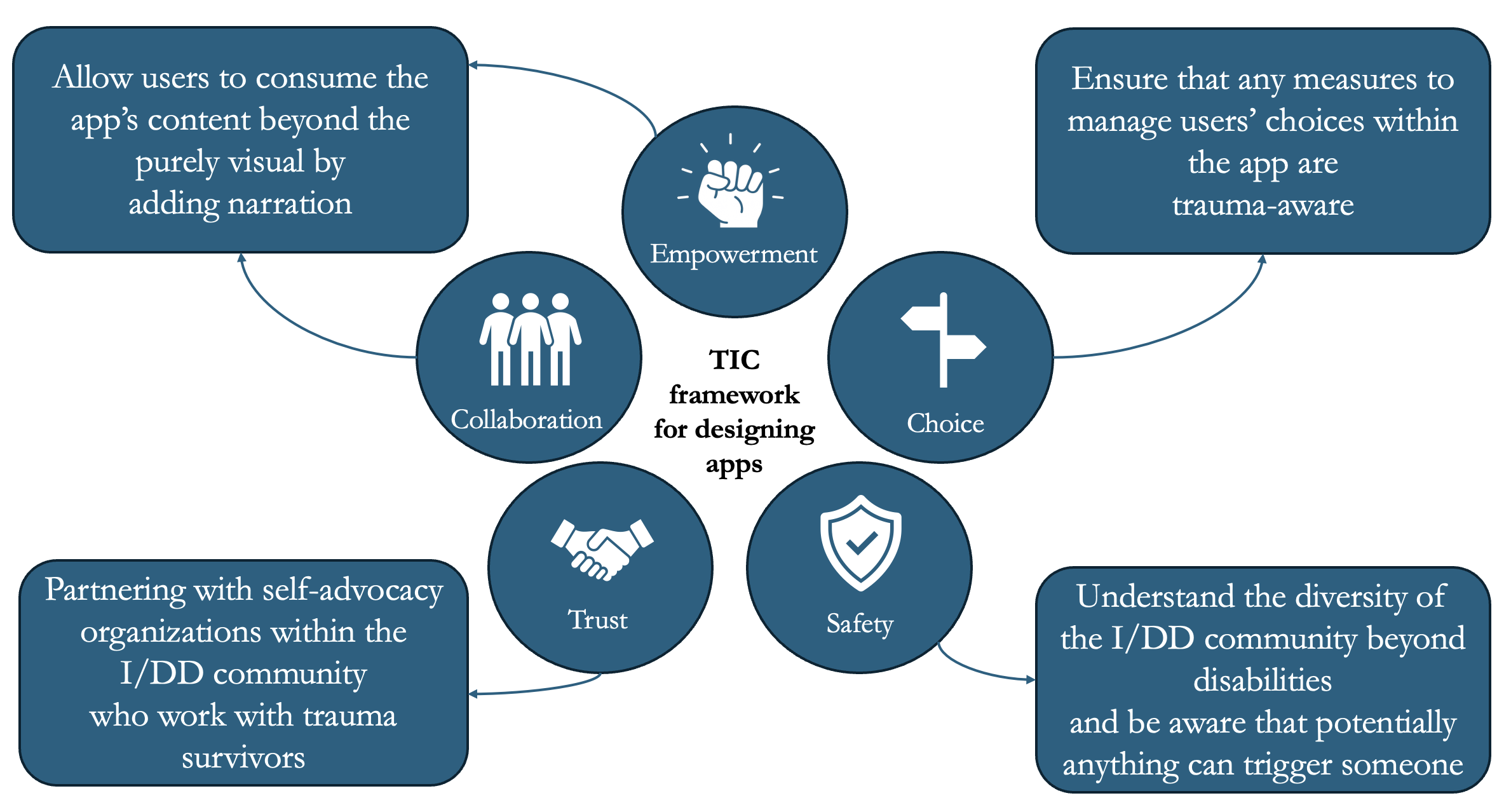
Considering Trauma in Accessible Design for People with I/DD

In the US, there are over million people with Intellectual and Developmental Disabilities (I/DD). Ideally, apps for the I/DD community should be designed to be I/DD-accessible. There has been some research in recent years that has looked into how to make apps I/DD-accessible. In this article, we posit that, in addition to these accessibility guidelines, designers should include an additional consideration: trauma. Further, we focus our discussion on the needs and desires of adults within the I/DD community. Over the past five years, our team has been working with the I/DD community to better understand the needs of this community and to co-design mobile computing apps with them, specifically apps that relate to helping adults with I/DD to independently manage trauma and abuse. It is based on this experience that we argue for considering trauma when designing I/DD-accessible apps.
Author(s). Krishna Venkatasubramanian, Tina-Marie Ranalli, Piriyankan Kirupaharan, and Liam Cannon
DIS

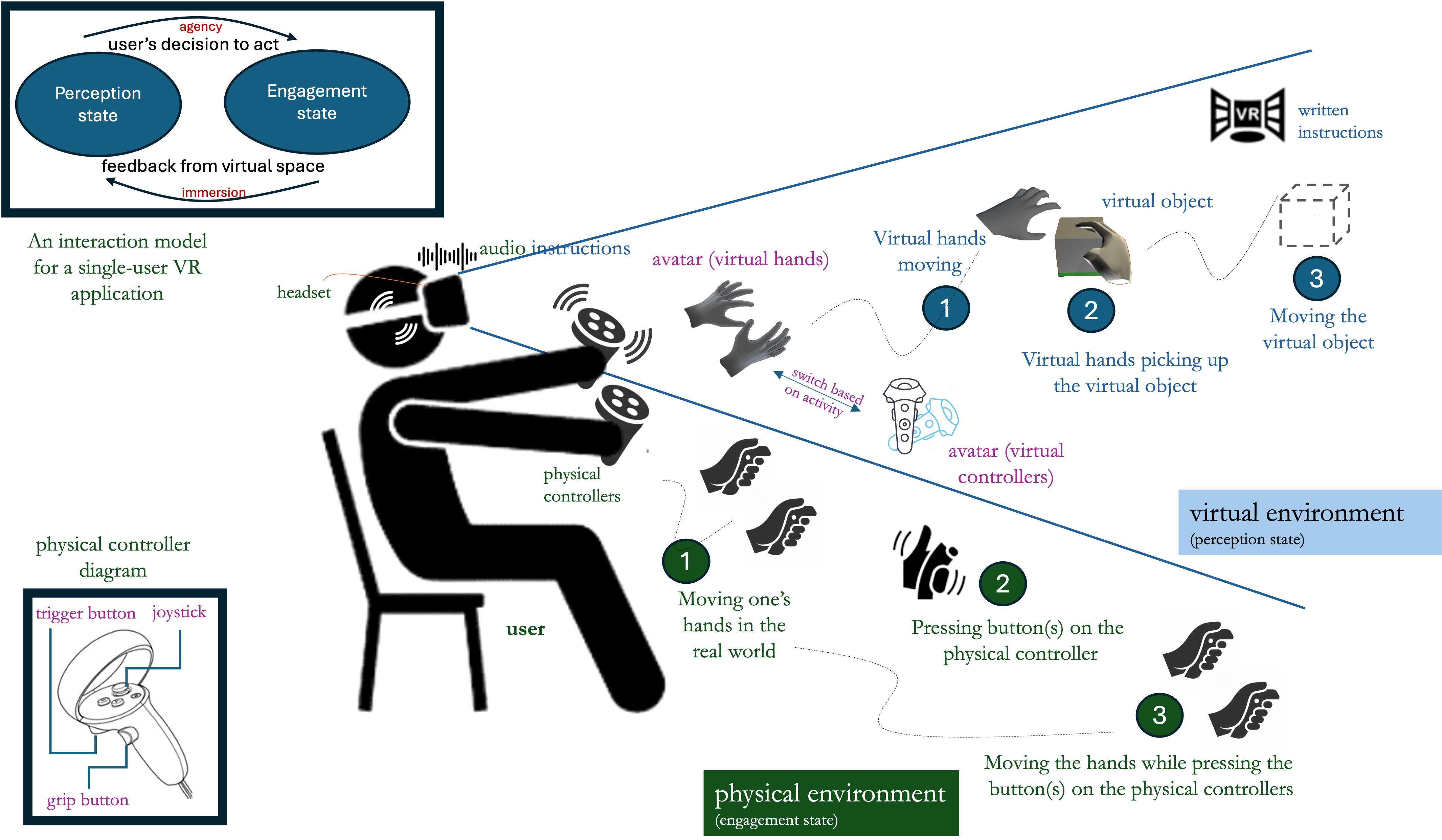
Understanding the Accessibility of Single-User virtual reality (VR) for Adults with I/DD

In this paper, we aim to understand accessibility issues for peoplewith intellectual and developmental disabilities (I/DD) withsingle-user VR applications. To this end, we recruited eight participants with I/DD for this study. We asked each participant to use asingle-user VR application (on Meta Quest 2) and then conducted semi-structured interviews about their experiences. Overall, we found that participants had difficulty: perceiving (including comprehending) the various elements of the virtual environment and using physical controllers to engage with (i.e., act within) the virtual environment. The participants then suggested potential improvements to make the virtual environments more accessible. Based on these findings, we call for further research in four broad areas to foster an accessible VR experience for people with I/DD.

Author(s). Piriyankan Kirupaharan, Tina-Marie Ranalli, and Krishna Venkatasubramanian
Loco

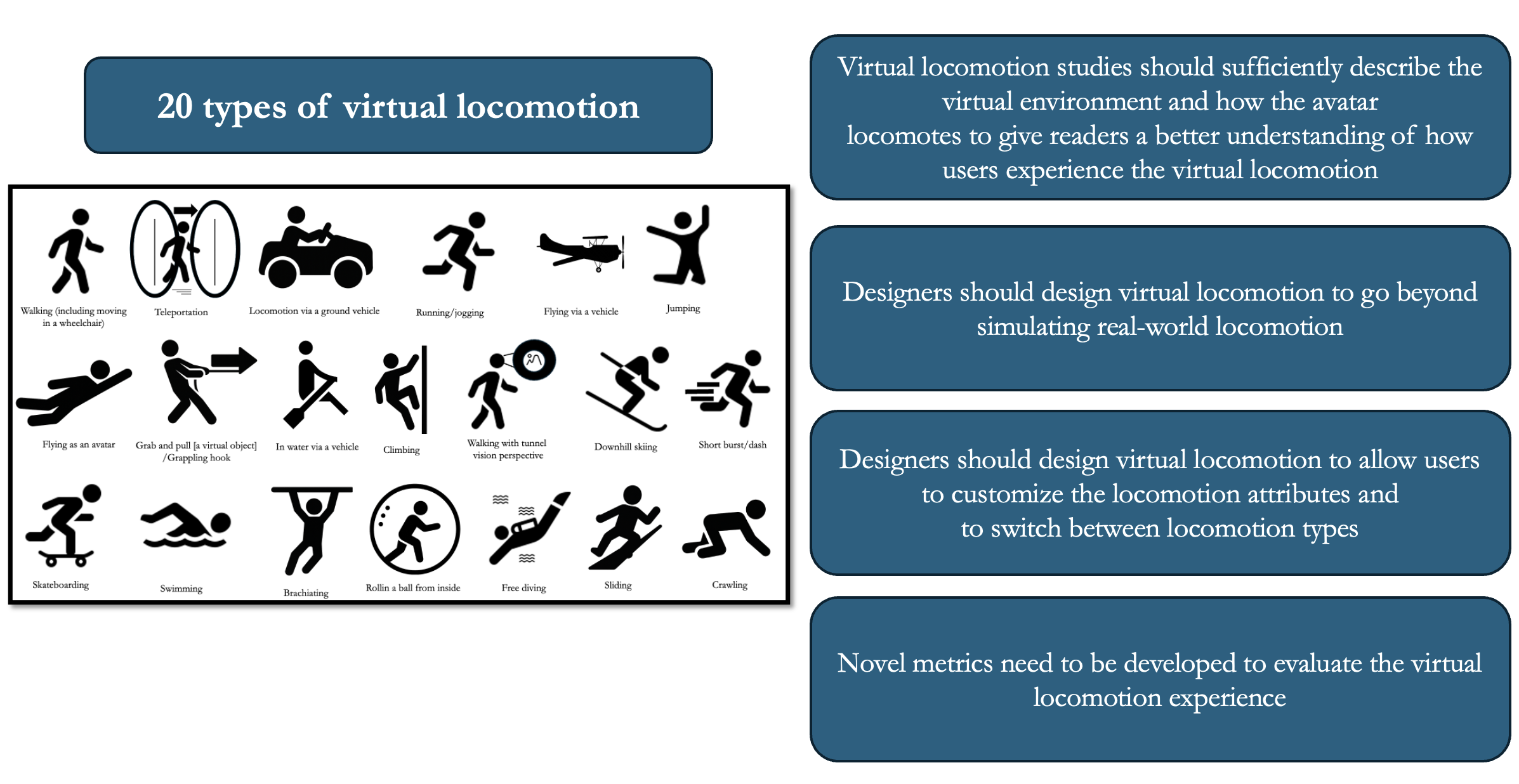
An analysis of locomotion as implemented in the virtual environment in virtual reality (VR) literature

Locomotion in virtual reality (VR), is the ability to travel to spatially distant locations in virtual environments. Locomotion is an essential element of the experience of virtual environments for VR users. In this paper, we present one of the largest and most comprehensive analysis of the VR literature from the last 15 years, through the lens of how virtual locomotion is implemented in virtual environments. We use the term virtual locomotion to exclusively mean the user experience of locomotion within the virtual environment, rather than the physical actions used to enable it. Overall, we found that walking and teleportation are the predominant types of virtual locomotion in the literature. We also found that the implementation of the named virtual locomotion types (e.g., walking) rarely matches their actual implementation in the virtual environment. Based on these findings, we suggest four areas for further research for VR locomotion.

Author(s). Piriyankan Kirupaharan, Tina-Marie Ranalli, Shadi Abtahi, and Krishna Venkatasubramanian